
China correspondent
Chinese scientists are in a battle to save one of the last large animal species living in the Yangtze River – and a complete ban on fishing in the region is helping them.
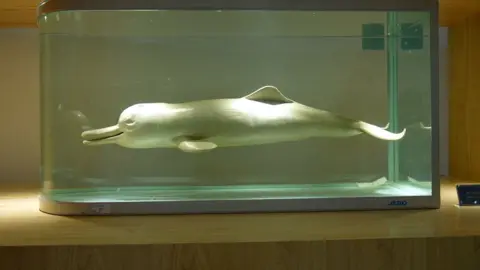
At the Institute of Hydrobiology in Wuhan, just 5km (3.1 miles) from the banks of the river, the preserved bodies of the now-extinct river dolphin (baiji in Chinese) and paddle fish sit silently behind panes of glass.
“Now that those have become extinct, we’re going to save the Yangtze river porpoise,” Professor Wang Xi tells the BBC. “It has become the most important animal here.”
It was in 2002 that the last known baiji died, 22 years after researchers at the Institute started caring for it. A year later, the last known paddle fish – a type of ray-finned fish which can grow to more than 3 metres – was accidentally caught by fishermen and, despite being radio tagged and released, disappeared.
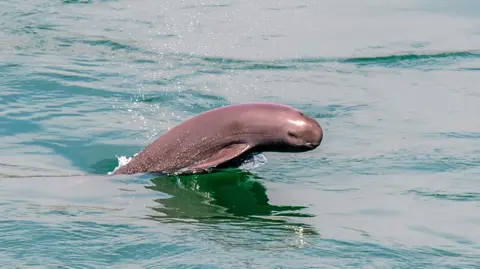
The goal now is to stop the Yangtze finless river porpoise – 1,200 of which remain in the wild, according to current estimates – from suffering the same fate.
“It’s the only top-level predator left in the river,” Professor Wang explains. “They are rare and their numbers reflect the health of the entire system’s ecology.”

The idea of a halt on all fishing was first conceived by Professor Cao Wenxuan from the Chinese Academy of Sciences (CAS) in 2006, but it took a lot more pressure from fellow scientists before a full 10-year-ban finally came into force nearly five years ago.
Enforced by police, the ban carries potential prison time for those caught fishing right along the Yangtze, as well as adjacent lakes and tributaries. It’s been hugely disruptive, and put 220,000 fishermen out of work.
Yet the finless porpoise, which belongs to the oldest living branch of the porpoise family tree, remains critically endangered today.
Those the BBC was shown at the Institute are being held in captivity to be studied by CAS. They can be seen from above the water or below, after taking the stairs down beside a deep tank where the observation area is located.
The scientists say they get excited in the company of humans, and they certainly appear to be showing off: racing through the water and swimming at speed, close to the glass with people on the other side. Swimming past, they seem to look at you with a mischievous smile.
In the wild, they are still hanging on where other species could not.
The construction of the main part of Three Gorges Dam in 2006 didn’t directly impact the finless porpoise, which don’t have to go upstream to spawn, although it did affect the fish they eat.
 Yang He
For other large marine animals, like the paddle fish or the Chinese sturgeon, the structure was catastrophic.
Wang Ding, a member of the International Union for Conservation of Nature (IUCN), who specialises in cetaceans like the finless porpoise, has dedicated his life to preserving the health of the Yangtze. He can see the good and the bad with these dams – and recalls how things used to be.
“Every flood season we’d have to organise a team with strong muscles, using many men, to go to sleep on the bank of the river, just in case a flood came,” he says. “Then, if the flood hit, everyone would do their best to try to keep the levy banks solid, to make sure they were not broken by the dangerous rushing water.”
Now, he says, the Three Gorges Dam mitigates against the flooding.
As Professor Wang points out, however, this massive, river-blocking structure also prevents the Yangtze’s giant sturgeons from reaching their spawning grounds.
While the endangered fish had briefly seemed to find an alternative location, he says, this is no longer the case – and these days sturgeons are only in the river because researchers are pouring them in, 10,000 at a time.

Despite over a million captive-bred sturgeon being released into the Yangtze last year, attempts to boost the population have been unsuccessful, as the fish are not reproducing by themselves in the wild.
So the finless porpoise doesn’t end up like this, Professor Wang and other scientists are hoping that the current complete fishing ban will continue after the initial 10 years is up.
Their research, published in the Bulletin of the Chinese Academy of Sciences, records a drastic increase in fish numbers since the ban came into effect in 2021.
Another threat to the finless porpoise, however, might be harder to resolve.
Wang Xi pointed out that “ships are very dangerous for animal’s brains because they are very noisy”.
This is said to produce a form of underwater noise pollution which distresses the animals.
Chinese scientists think that the sound from ships may have contributed to the demise of the Yangtze’s baiji river dolphins, which used sonar to communicate.
But it’s one thing to ban fishing – it would be quite another to completely stop the busy river traffic which delivers passengers as well as goods, and provides lifeblood for much of central China’s economy.
More achievable was forcing factories which produce chemicals to move away from the Yangtze. Thousands of these have been shut down or relocated over the past decade, in a move that is said to have significantly improved the river’s water quality.
There has also been community involvement in the porpoise preservation push.
 Yang He
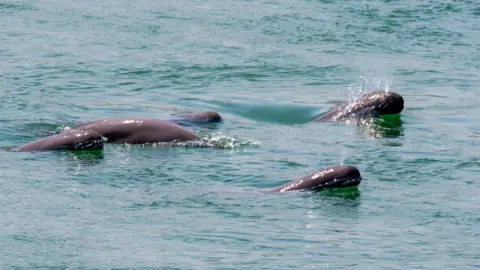
After retirement, Yang He took up amateur photography. Now, he says, he goes to the river every day with his camera equipment trying to spot the animals.
When he gets some good shots he forwards them to the scientists, who say he’s doing a better job than almost anyone tracking their progress.
Mr Yang says he once saw a porpoise in distress which had been caught in some netting. He notified the local authorities, who shut down that section of river to all shipping until it could be rescued – and it turned out the soon-to-be freed porpoise was pregnant. He felt pretty good about that, he says.
It is the porpoise numbers, however, that tell the most convincing story.
In the 1990s there were 3,300 finless porpoises in the wild. By 2006 this had halved.
Then the fishing bans came in, the factories were moved and the decline stopped. Not only that, but over the last five years of records, porpoise numbers have gone up by nearly a quarter.
Scientists are proud of these numbers – and the implications they hold for the health of the environment more broadly.
“We’re saving the finless porpoise to save the Yangtze River,” says Wang Ding. “This is like a great mirror, to have an idea how well we have been doing protecting this ecosystem.
“If the porpoises are doing fine, if their numbers are increasing, this means the ecological health of the whole river is also improving.”