Meet AMIES, China’s new hope in breaking reliance on ASML’s chipmaking machines

AMIES Technology, a new Chinese lithography equipment manufacturer that showcased its latest chipmaking products at an industry event in Shenzhen last week, is offering renewed optimism in the nation’s drive to reduce its dependence on Dutch giant ASML.

The company presented a wide range of products – including compound-semiconductor lithography machines, laser-annealing systems, advanced inspection tools and solutions for packaging and wafer bonding – at the WeSemiBay Semiconductor Ecosystem Expo 2025, which featured more than 600 exhibitors, such as Huawei Technologies partner SiCarrier.

Advanced lithography remains a significant bottleneck in China’s chipmaking ambitions. The country still trails far behind global leaders in the technology and is restricted from acquiring ASML’s top deep ultraviolet (DUV) and extreme ultraviolet (EUV) systems due to US export controls.

Do you have questions about the biggest topics and trends from around the world? Get the answers with SCMP Knowledge, our new platform of curated content with explainers, FAQs, analyses and infographics brought to you by our award-winning team.

Founded in February, AMIES is a spin-off from China’s leading lithography company, the state-owned Shanghai Micro Electronics Equipment (SMEE). While SMEE focuses on developing essential front-end tools, AMIES aims to commercialise equipment more swiftly, according to Chinese media reports, citing company representatives.

US-sanctioned SMEE excels in back-end semiconductor processes like packaging, which often require less advanced lithography technology. When it comes to front-end wafer fabrication, however, it is still trying to catch up with Western leaders such as ASML.

AMIES was spun off from SMEE in February. Photo: Handout alt=AMIES was spun off from SMEE in February. Photo: Handout>

The Chinese company’s most reliable production-grade lithography tools are believed to support processes around 90-nanometre node and above. In late 2023, its shareholder Zhangjiang Group briefly claimed on social media that SMEE had “successfully developed a 28-nm lithography machine”, but later retracted the reference.

In contrast, ASML’s EUV systems are used by leading chipmakers for processes at 2-nm nodes and below.

For now, AMIES said its flagship product is its advanced packaging lithography machine, which held a global market share of 35 per cent and a 90 per cent share in China.

On its website, AMIES lists four product lines: integrated circuits, advanced packaging, compound semiconductors and flat-panel displays. These encompass various types of annealing, inspection, chip manufacturing and packaging tools.

In August, the company said it shipped its 500th stepper lithography machine. Steppers expose chip patterns on wafers one section at a time, unlike scanners, which continuously move the mask and wafer for faster, more precise exposures.

AMIES received an award at the China International Industry Fair in September for its “next-generation fan-out packaging lithography system”.

The company has received solid state support. AMIES’s nearly 30 shareholders include local government-backed funds such as Shanghai Information Investment, Spinnotec, the venture arms of Zhangjiang Hi-Tech Park and Citic Group, alongside a number of private equity investors, according to the Chinese corporate database Tianyancha.

AMIES said it had a technical team of 600 people, with an average age of 33, and 65 per cent holding master’s or doctoral degrees.

As part of China’s broader push for chip self-reliance across the supply chain, various players are racing to develop domestic DUV and EUV tools. Shenzhen-backed chip equipment firm SiCarrier, for example, is reportedly working on advanced-node lithography machines, although it has not publicly unveiled such products.

Zetop Technologies – partially owned by SiCarrier and the US-sanctioned Changchun Institute of Optics, Fine Mechanics and Physics under the Chinese Academy of Sciences – counts key EUV optics researchers among its shareholders.

Shanghai-based Yuliangsheng, in which SiCarrier also has a stake, supplied a 28-nm DUV system to Semiconductor Manufacturing International Corporation, China’s largest semiconductor foundry, for testing in 7-nm chip production, according to a Financial Times report in September.

In the third quarter, ASML reported total net sales of €7.5 billion (US$8.8 billion), with China accounting for 42 per cent of system orders.

However, ASML expected a sharp decline in demand from China next year, as tensions between the US and China, coupled with Beijing’s recent export controls on rare earth materials essential for ASML’s machines, have further complicated the global semiconductor supply chain.

This article originally appeared in the South China Morning Post (SCMP), the most authoritative voice reporting on China and Asia for more than a century. For more SCMP stories, please explore the SCMP app or visit the SCMP’s Facebook and Twitter pages. Copyright © 2025 South China Morning Post Publishers Ltd. All rights reserved.

Copyright (c) 2025. South China Morning Post Publishers Ltd. All rights reserved.


Source link

Visited 3 times, 3 visit(s) today

Related Article

Ottawa exempts more U.S. and Chinese aluminum and steel imports from retaliatory tariffs

Ottawa exempts more U.S. and Chinese aluminum and steel imports from retaliatory tariffs

The Liberal government is facing pushback after exempting a series of Chinese and U.S. steel and aluminum imports from retaliatory tariffs.  A new order-in-council shows Ottawa has now granted dozens of Canadian companies relief so they don’t have to pay the price for retaliatory tariffs on specific products that businesses argued are in short supply

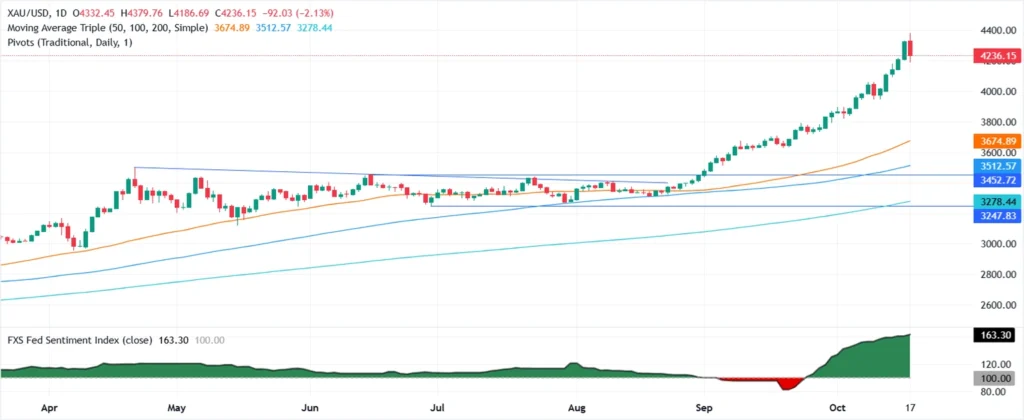
Gold daily chart

Gold crashes 2% from record high as Trump tempers threats on China

Gold price (XAU/USD) falls 2% after reaching a record high at $4,379 earlier on Friday, tumbles below $4,250, sponsored by US President Donald Trump’s comment that triple-digit tariffs on China are unsustainable. At the time of writing, Bullion prices hover at around the $4,230 – $4,240 range. Bullion tumbles below $4,250 as risk appetite returns

The new trade actions were Trump's reaction to China dramatically expanding its export controls on rare earth elements. (Bloomberg)

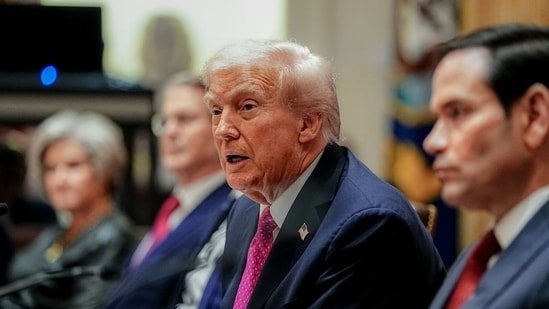
Trump says 100% tariffs on China not sustainable, still plans to meet Xi

US President Donald Trump said his proposed 100% tariff on goods from China would not be sustainable, but blamed Beijing for the latest impasse in trade talks that began with Chinese authorities tightening control over rare earth exports. The new trade actions were Trump’s reaction to China dramatically expanding its export controls on rare earth

iPhone Air sells out almost instantly in China

iPhone Air sells out almost instantly in China

When Apple first released the iPhone Air last month, it was missing from a key market: China. This was because the iPhone Air is eSIM-only due to its ultra-thin design, and China has strict regulations about eSIM technology. Today, however, the iPhone Air officially went up for pre-order in China — and indications are it’s

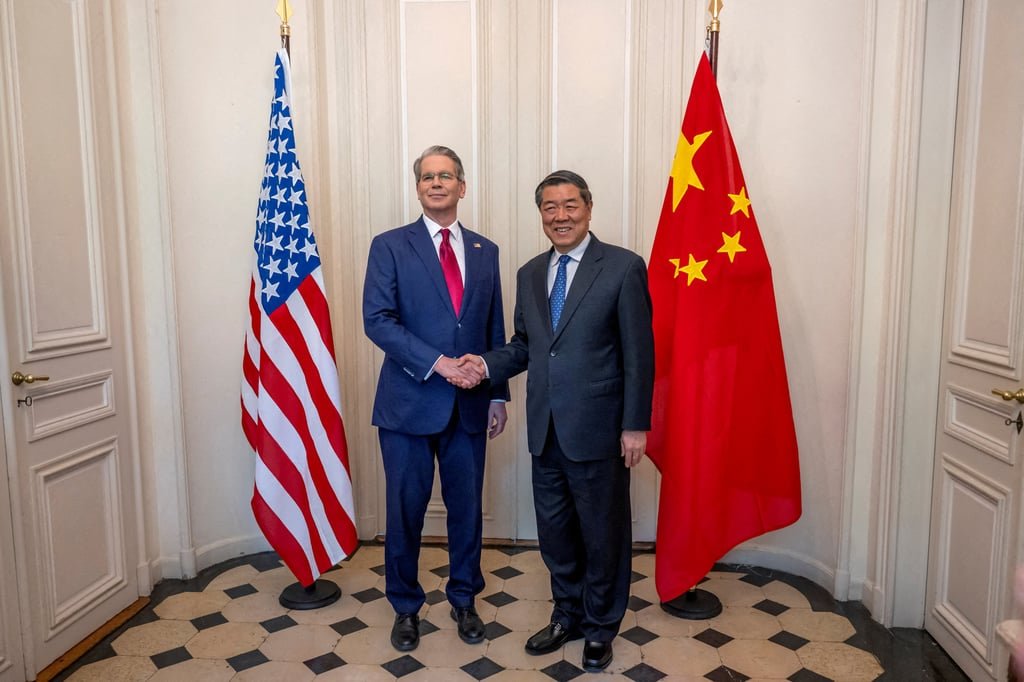
US Treasury Secretary Scott Bessent (left) shakes hands with Chinese Vice-Premier He Lifeng during a bilateral meeting between the US and China in Geneva in May. Photo: Reuters

US-China tensions ease as Bessent confirms call with counterpart He Lifeng

US Treasury Secretary Scott Bessent confirmed plans to speak with Chinese Vice-Premier He Lifeng on Friday in a further sign of easing tensions ahead of a potential meeting between the two countries’ leaders. “The vice-premier, who is my counterpart, and I will be speaking this evening at around 8.30, 9 o’clock,” Bessent said at the

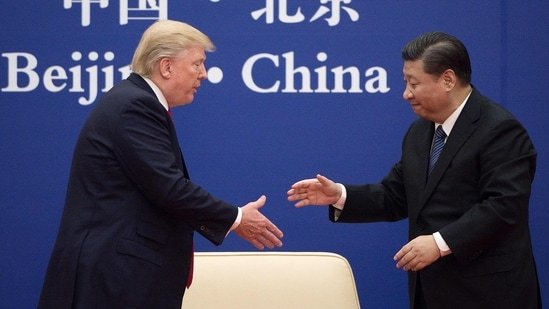
Will Trump and Xi’s shock tactics ruin any chances of ending the US-China trade war?

Will Trump and Xi’s shock tactics ruin any chances of ending the US-China trade war?

Blame games, tit-for-tat threats, off-again on-again meetings between US President Donald Trump and Chinese President Xi Jinping, and wild tariff swings seem to be the recent order of the day. According to former government officials and analysts, however, this should come as no surprise – it’s just the price you pay when diplomatic norms are